As a history minor and someone who has studied the Cold War for years, I would consider myself someone who has good knowledge of the time period and its events. I know about the ideological struggle between American and the Soviet Union, the ways in which communism was trying to be contained, and the fall of the Soviet Union along with its impact, but there were some global events that Westad’s reading contained that I had not known about in third world countries. One thing that I felt that the readings helped me learn was the intensity of and deeper significance of the impact of the Cold War and Cold War ideology on third-world countries. For instance, I knew that the Soviet Union had spread communism throughout parts of Europe and Asia, but I did not know that Mongolia was used as a testing ground for Soviet ideology. Since China had lost control of the Mongolian government, the Bolsheviks interfered in the country by implementing “the methods of education, cultural work, collectivization, an antireligious propaganda” that would later become the policy of the Soviet Union used in other third world countries (Westad, 51). I would have never guessed that Mongolia of all countries was the first third-world country to adopt communism from the Soviet Union. The way that the Soviet Union used to dominate Mongolia with their ideology was not the same as the imperialism that I knew was prevalent during the Cold War era, but it shared more similarities with colonialism. Colonialism requires for the Russian to settle into the territory and control the territory through expressing their authority and having the indigenous people assimilate into their more dominant ideological and cultural aspects, which the settled Russian Bolsheviks and soldiers did in Urga, Mongolia. It is even stranger when you consider the fact that Russia is typically excluded from discussions concerning colonialism.
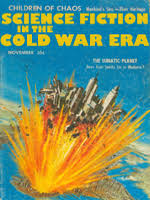
Looking back on this thought, it makes complete sense that the Cold War era would have such a polarizing effect on science fiction that I never would have otherwise noticed. The political climate of the Cold War and the ideological struggles between the United States and the Soviet Union that ensued definitely impacted the feelings of the future and utopia/dystopian societies. Authors would write science fiction novels containing nationalistic ideals that would portray utopian societies as those who followed their perceived “correct” ideology, or they would portray a dystopia as a society using a competing ideology or a world ravaged by the wars that the Cold War could have developed into. Obviously, the perception of a “correct” or “incorrect” ideology is determined by which side you supported: capitalism or communism. Even stories involving aliens invading Earth and forcing their way of life on people can be comparable to the Soviet Union forcing their communist ideals upon the people of Mongolia.
There are aspects of the Cold War that are so heavily historically and philosophically rooted in science fiction that I did not realize until I started engaging myself with the genre. Themes like paranoia, which was prevalent in the Cold War because of the constant threats of Russian or American spies, are not themes that I would have normally related back into science fiction works like “Do Androids Dream of Electric Sheep?” because you cannot tell who is human or an android. You could probably even argue that androids were used as a foil to humans in the novel to represent the “emotionless other faction” that has done only wrong in your perspective. As someone who studies history and has never been an active reader of science fiction, the seemingly endless connections that can be drawn between the Cold War and science fiction strike me as very intriguing.
Works Cited:
- Westad, O. The Global Cold War: Third World Interventions and the Making of Our Times. Cambridge; New York: Cambridge University Press, 2007.